DeepSeek's Agent Framework: Even the Agent Loop Is a Plugin
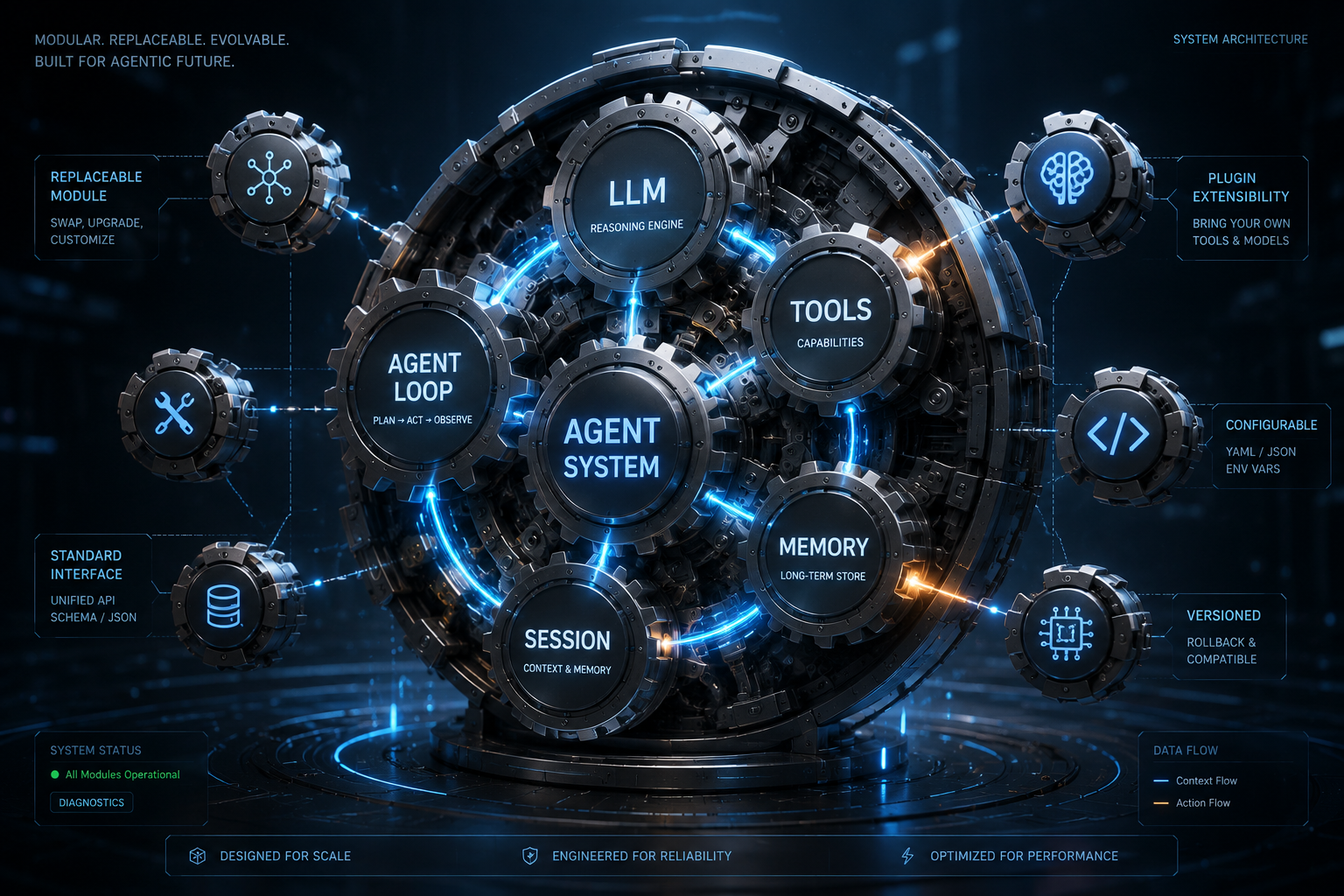
DeepSeek open-sourced an Agent Harness. 40+ packages, 20+ capability seams — the most notable thing: the Agent Loop itself is a plugin, swappable from a YAML config.
This article breaks down how “everything is a plugin” works, from the bottom up.
The one-liner
DeepSeek Harness is a plugin-architecture-based Agent runtime. The entire product — including the core Agent Loop — is assembled from plugins. There is no privileged core whose implementation you’re stuck with.
Want a different LLM adapter? Write a plugin. A different filesystem backend? Write a plugin. A different Agent Loop? Write a plugin.
# One line to start the Web UI, default http://127.0.0.1:3080
npx @deepseek-ai/dsh web
But “plugin-ization” isn’t something you achieve by shouting a slogan. It requires a complete design from the lowest-level mechanism to the highest-level application. Let’s work our way up, layer by layer.
1. The foundation: Cordis plugin framework
The foundation of “everything is a plugin” is a framework called Cordis. DeepSeek Harness vendors Cordis in its entirety — all plugin capabilities are built on top of its mechanisms.
Cordis has a small set of core concepts:
flowchart TD
    Plugin["Plugin<br/>object implementing a Service interface"]
    Context["Context<br/>service registry ctx.key"]
    Inject["Inject<br/>declarative dependency injection"]
    Events["Typed Events<br/>type-safe event communication"]
    Effects["Effects<br/>reversible registration = cleanable"]

    Plugin -->|"mounts to"| Context
    Plugin -->|"declares needs"| Inject
    Context -->|"dispatches"| Events
    Plugin -->|"registers via effect/on"| Effects
    Effects -->|"auto-cleaned on unmount"| Context

    style Plugin fill:#e3f2fd
    style Context fill:#e8f5e9
    style Events fill:#fff3e0
    style Effects fill:#fce4ec
The most interesting bit is the reversibility of Effects. Everything a plugin registers — tools, prompt snippets, event listeners — goes through ctx.effect() or ctx.on(), and gets cleaned up automatically on unmount. That sounds simple, but read through enough Agent framework plugin systems and you’ll find almost none of them actually do it — either the registration lives forever, or unmounting leaves state behind.
Cordis provides the effect mechanism at the base layer; DeepSeek Harness is the first framework I’ve seen apply it at the Agent-framework level: registration is a side effect, unmount is cleanup, guaranteed at the framework level. This is the prerequisite for the entire “replaceability” story — if plugins can’t clean up after themselves, who would risk swapping components?
2. The pattern: Capability Seam (three-role separation)
With a plugin framework in place, the next question is: how do you organize “capabilities” using the plugin framework?
“Adding a capability” in most frameworks means writing a function and registering it in a tool table. When something breaks you dig through source to find the interface, and switching backends means touching the Consumer.
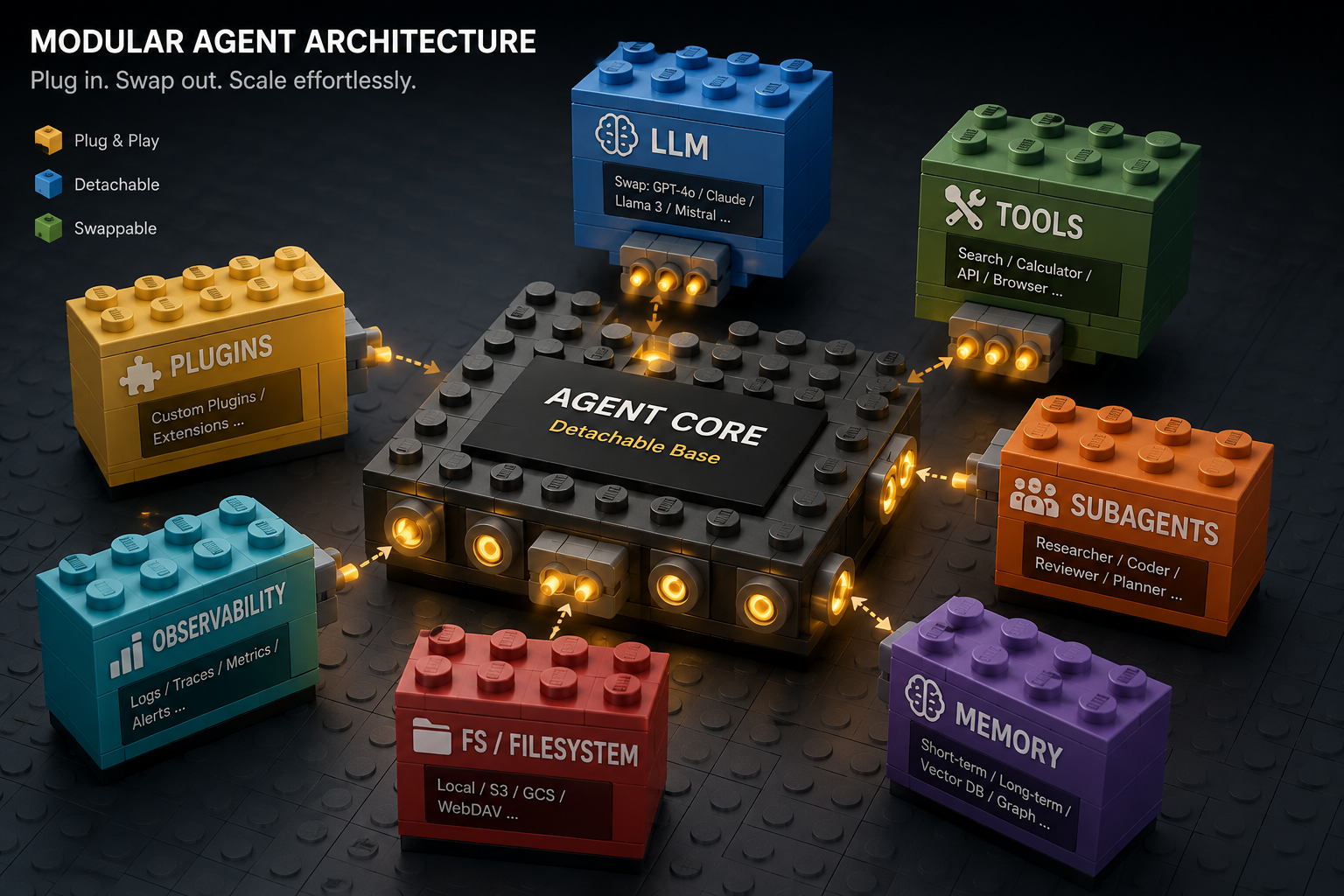
DeepSeek Harness formalizes “capability” into three roles, called a Seam:
flowchart LR
    SD["Service Definition<br/>declares interface + ctx key<br/>(abstract class / registry)"]
    SP["Service Provider<br/>implements interface<br/>(can be several)"]
    Consumer["Consumer<br/>uses interface<br/>(usually a model tool)"]

    SD -->|"implemented by"| SP
    SD -->|"injected into"| Consumer
    SP -->|"supplies"| Consumer

    style SD fill:#e3f2fd
    style SP fill:#e8f5e9
    style Consumer fill:#fff3e0
Taking the Shell capability as an example:
| Role | Package | Responsibility |
|---|---|---|
| Service Definition | dsh-shell | Declares the ctx.shell interface and types |
| Service Provider | dsh-bash-local | Local bash execution |
| Service Provider | dsh-bash-sandbox | Sandboxed bash execution |
| Consumer | dsh-tool-bash | The bash tool the model sees |
Swapping a Provider doesn’t touch the Consumer. To go from local execution to an E2B remote sandbox, swap one provider package — the tool definition stays exactly as it is. This is where “replaceability” lands in the code.
The repo has 20+ such seams:
| Domain | Seam | Provider count |
|---|---|---|
| Model | ctx.llm | 3 (DeepSeek / pi-agents / replay) |
| Filesystem | ctx.fs | 3 (local / e2b / sandbox) |
| Subprocess | ctx.subprocess | 2 (local / e2b) |
| Shell | ctx.shell | 2 (bash-local / bash-sandbox) + pwsh |
| Terminal | ctx.terminals | 1 (terminal-bash) |
| Subagents | ctx.subagents | 6 (spawn/fork/sdk/ACP/Codex/Claude Code) |
| Sandbox | ctx.sandbox | 3 backends (bwrap / Landlock / Seatbelt) |
| Web | ctx.web | 4 (Exa / Perplexity / DeepSeek search / HTTP fetch) |
| LSP | ctx.lsp | 1 (stdio) |
| Persistence | ctx.sessionPersistence | 2 (JSONL / SQLite) |
The 6 subagent backends include providers that talk directly to Codex and Claude Code. The sandbox also comes in three flavors (bwrap / Landlock / Seatbelt), covering Linux, macOS’s newer security module, and the classic macOS sandbox.
3. The application: Agent Loop is a plugin
With Cordis’s plugin mechanism and the Seam three-role pattern, “Agent Loop is a plugin” is no surprise — it’s the most natural outcome of the system.
In most Agent frameworks the loop is hard-coded — changing execution strategy means changing core code. DeepSeek Harness makes the Loop a ctx.agentLoop service, on equal footing with every other service. You specify which implementation to use in cordis.yml.
Extending it doesn’t require editing source or writing monkey patches:
- Swap the LLM adapter → register a new
ctx.llmprovider - Swap the filesystem backend → swap the
ctx.fsprovider (local → E2B sandbox) - Swap the Agent Loop → swap
ctx.agentLoop - Add an approval policy → listen to
agent/*events
Agent event flow
A single agent interaction splits into two layers, Turn and Step:
- Turn — one complete input consumption, from model through tool execution to the end
- Step — one model request plus the tool calls it triggers
sequenceDiagram
    participant User as User/Input
    participant AgentLoop as Agent Loop
    participant Prompt as Prompt Assembly
    participant LLM as LLM Adapter
    participant Tools as Tool Pipeline

    User->>AgentLoop: turn/start
    AgentLoop->>AgentLoop: claim input + queue messages
    AgentLoop->>Prompt: assemble prompt sections + tool schemas
    AgentLoop->>AgentLoop: agent/pre-step (waterfall)
    AgentLoop->>LLM: step/start → agent/request → llm/stream
    LLM-->>AgentLoop: assistant/chunk* → assistant/message
    AgentLoop->>Tools: tool/call → pre-execute → execute → post-execute → result
    Tools-->>AgentLoop: tool/result
    AgentLoop->>AgentLoop: step/end
    alt more tool requests or new input
        AgentLoop->>AgentLoop: next step
    end
    AgentLoop->>AgentLoop: agent/turn-stopping (serial)
    AgentLoop-->>User: turn/end
Events live in three domains:
| Event domain | Persisted? | Purpose |
|---|---|---|
session/* | ✅ written to log | facts that survive restarts |
agent/* | ❌ real-time | observe/intercept a live Agent |
| Capability-domain events | ❌ real-time | attach policy and adapters to seams |
Waterfall events (agent/pre-step, agent/request, llm/stream, tools/*) are around-middleware — listeners must delegate via next(), and the chain short-circuits if they don’t. Same pattern as Express/Koa middleware, but type-safe.
4. Operations: Session Log as the single source of truth
Components are replaceable, the runtime runs — but how do you trace problems when things go wrong?
What does the model actually see during a run? Most frameworks only keep a prompt log; session history, tool calls, and context injection are scattered around.
DeepSeek Harness builds an append-only event stream called the Session Log, and derives every fact from it:
flowchart TD
    subgraph SessionLog["Session Event Log"]
        direction TB
        E1["user/message"]
        E2["assistant/chunk"]
        E3["assistant/message"]
        E4["tool/call"]
        E5["tool/result"]
        E6["turn/start · turn/end"]
        E7["step/start · step/end"]
    end

    Model["model request"] -->|"deriveMessages()<br/>built-in message derivation"| SessionLog
    UI["Web UI rendering"] -->|"session/event"| SessionLog
    Persist["persistence<br/>JSONL / SQLite"] -->|"write"| SessionLog
    Fork["Fork / Resume"] -->|"copy from"| SessionLog
    Telemetry["telemetry"] -->|"derive"| SessionLog

    style SessionLog fill:#e3f2fd
There’s one rule that’s enforced especially hard: model-visible must be logged.
This isn’t a “suggestion” — there’s a runtime invariant assertion in the code. If something reaches a model request but can’t be rebuilt from the session log, it errors out.
Practical payoff: you changed a context-injection rule — how do you confirm the model actually saw it? Check the log. No corresponding event in the log, and the model definitely didn’t see it. Fork, Resume, telemetry — all derived from that one stream, no second set of state to maintain.
The “model-visible ⟺ logged” invariant is the single most portable Agent design principle I’ve come across. It turns “what the model sees must be traceable” from a best practice into a runtime check.
5. Configuration: Profile + Bundle + Patch
Components are replaceable, the log is traceable — but how do you compose all these pieces into a working Agent?
Agent run modes differ a lot: the Web UI needs a server plus frontend, Headless is a one-shot runner, ACP speaks JSON-RPC. Most frameworks either hard-code a few modes or cobble them together from env vars.
DeepSeek Harness uses three layers:
flowchart TD
    Profile["Profile<br/>named composition<br/>(web / headless / acp)"]
    Bundle["Bundle<br/>installable plugin layers<br/>(base / web-app / headless)"]
    Patch["Patch<br/>config overrides<br/>(cordis.patch.yml)"]

    Profile -->|"includes multiple"| Bundle
    Profile -->|"stacks"| Patch

    Base["dsh-base<br/>model + tools + persistence + sandbox"]
    WebApp["dsh-web-app<br/>browser app"]
    Headless["dsh-headless<br/>one-shot runner"]

    Bundle -.-> Base
    Bundle -.-> WebApp
    Bundle -.-> Headless

    style Profile fill:#e3f2fd
    style Bundle fill:#e8f5e9
    style Patch fill:#fff3e0
- Profile — a named composition;
webandheadlessship out of the box - Bundle — a distributable plugin layer; a profile stacks multiple bundles
- Patch — a YAML override; replace any config line or insert new ones
Boot order: Bundle → profile-level patch → home-level patch → --patch CLI override.
# Inspect the actual config tree that boots
dsh --profile web --dump-config
Any line of the output can be replaced by a patch. Editing YAML has a lower bar than editing code, so operators can tune Agent behavior without touching source.
6. Quality: docs as code
Architecture, operations, and configuration are all in place — but what’s the biggest fear for an open-source project? Docs and code drifting apart. Over time, the docs say one thing and the code does another. New contributors walk in confused.
DeepSeek Harness’s answer isn’t “people should be disciplined” — it’s making doc consistency a CI gate:
A type definition pasted into the docs doesn’t match the source? CI fails. A broken link? CI fails. An exported function missing JSDoc? CI fails. Docs over the word budget? CI fails.
Any non-trivial code change must ship with an Agent Note (a design-decision doc) in the same PR. Not a suggestion — a gate. No note, no merge.
This level of quality control is rare in open source. But it has a prerequisite — the architecture layers above must be stable first, so there’s bandwidth for this kind of engineering infrastructure. Don’t treat “docs as code” as step one. It’s the last step.
7. Comparison and trade-offs
If you were to place DeepSeek Harness on a coordinate system, the opposite end would be Pi Agent — a minimalist coding agent.
| Dimension | Pi | DeepSeek Harness |
|---|---|---|
| Design philosophy | Cut what you can | Split what you can |
| Agent Loop | Hard-coded | Replaceable, configurable from YAML |
| Plugin-ization | Light extension | Everything-as-a-service, 40+ packages |
| Self-modification | Human configures it | Agent can mount/unmount its own plugins |
| Learning curve | Low | High (40+ packages) |
Neither direction is right or wrong — it depends on the scenario.
Where this is worth referencing
- Building a highly-customizable Agent platform — the three-role capability seam separation ports directly
- Need multi-backend switching (local / sandbox / remote) — the Provider pattern is the standard answer
- Session reliability matters — the “model-visible ⟺ logged” invariant
- Team-grade agents need access control — approvals + sandbox backends combined
Where it’s not a fit
- Lightweight personal tools — Pi’s “light Harness” fits better; 40+ packages is over-engineering for a personal tool
- Rapid prototyping — the declarative config + three-layer composition learning curve doesn’t suit fast trial-and-error
- Non-TypeScript stacks — it’s deeply tied to the TypeScript type system; porting cost is high
Directly reusable design principles
- Build capabilities as three-role seams — split Service Definition / Provider / Consumer so swapping a Provider never touches the Consumer
- Make the session log the single source of truth — what the model sees must be reconstructible from one log stream
- Registration as side effect, unmount as cleanup — don’t manage lifecycle by hand
- Keep config declarative — YAML composition over code if-else
- Turn “model-visible ⟺ logged” into a runtime assertion — a gate, not a guideline
Closing
Pi is “cut what you can”, DeepSeek Harness is “split what you can”. What they share is having thought hard about “what belongs in the framework and what doesn’t” — Pi’s answer is “as little as possible”, DeepSeek’s is “everything pluggable”.
If you’re building an Agent platform, three design ideas are worth taking with you:
- Capability Seam three-role separation — Providers are replaceable, Consumers don’t change
- Session Log as source of truth — what the model sees must be traceable, enforced as a runtime invariant
- Replaceable Agent Loop — even the most “core” component doesn’t have to be a privileged core
Appendix: Basics
| Item | Value |
|---|---|
| Repo | deepseek-ai/deepseek-harness |
| Version | 0.1.0-rc.5 (developer preview) |
| License | MIT |
| Runtime | Node.js 22.19+ / 24+ |
| Package manager | pnpm 11.7 workspaces |
| Underlying framework | Cordis (vendored, has a paper) |
| Package count | 40+ npm packages (@deepseek-ai/dsh-*) |
| Build | tsc + tsdown |
| Testing | 5 layers, including a 100% line-coverage gate |
References
- DeepSeek Harness repo — verified: README, AGENTS.md, architecture.md, development.md, cordis-primer.md, packages/README.md
- Cordis framework
- Cordis paper: A Programming Paradigm for Spatiotemporal Composability (not line-by-line verified)
- Comparison reference: Pi Agent Design Philosophy