Pi Agent Design Philosophy: From Bare-Bones to Light Harness
From “bare-bones apartment” to “lightweight harness” — what Pi Agent cut away says more about its design philosophy than what it kept. This post dissects six key decisions, and ends with 5 practical suggestions for building your own harness.

I recently spent some time studying Pi’s design, and organized a few observations worth sharing.
The Conclusion Up Front
One sentence: light harness — give the context window back to the model, push complexity to the boundaries (into your todo.md, your extension store, that extra terminal you keep open).
This post won’t list features. It dissects one thing: why Pi dares to cut features so aggressively. By the end you’ll see that its “absence list” explains its design philosophy better than its “feature list.”
At First I Thought It Was a Bare-Bones Shell
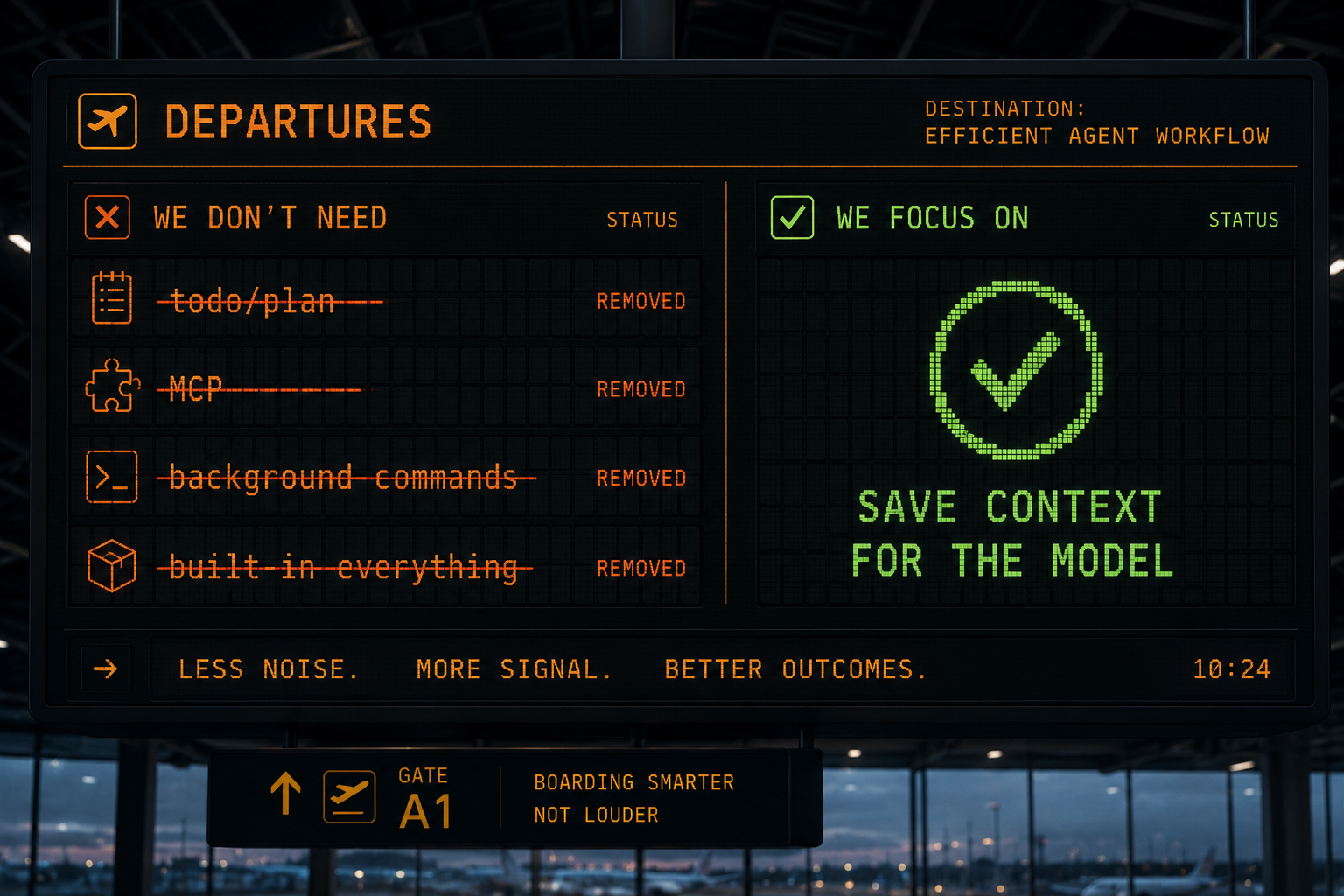
My first reaction to Pi’s default config was: this is too bare-bones. No todo, no plan, no permission prompts, no MCP, no background commands — I’ve seen minimalism, but never this aggressive.
Author Mario Zechner explains in his blog post: top models have been trained with heavy RL, so they perform well even with lean context. A Zhihu post about “furnishing the Pi bare-bones apartment” puts it more plainly: many harness features are just ornament carved into the context — every added rule drains a slice of the model’s attention. Plus Databricks’ benchmark shows Pi’s pass-rate-per-dollar beating Codex and Claude Code on the same models. The rationale seems solid.
— But before you take my word for it: all three data points are second-hand. I haven’t verified them line by line against the originals. Treat them as directional signals.
After using it for a while, it clicked: Pi isn’t “short on features,” it’s deliberately not building them. A bare-bones apartment just hasn’t been furnished yet; Pi weighed the options and decided not to furnish. The calculus: what’s scarce isn’t features, it’s context — so don’t pile complexity into the prompt, push it outside the system. This echoes the logic of the memory-management framework: deciding what an agent remembers and forgets is, at bottom, bargaining over a scarce resource.
The Best Cut: Constraints Written Into the API
There’s no “you may not delete files” rule text in Pi — its approach is simpler: full YOLO, bash runs anything.
But there’s a design idea worth savoring: sink “what you must not do” from the rules layer down to the capability layer. A tool that doesn’t exist can stop an agent better than ten lines of “forbidden.” Pi didn’t take that road, but its “light” philosophy points in that direction. I initially thought the author was lazy; turns out he was clever.
The same knife cuts twice: low-frequency capabilities stay out of context. Pi’s extension tools (e.g., CLI tools) load on demand — tool definitions aren’t registered in the default context; only what you use gets attached. Low-frequency features don’t burn long-term budget. That’s the “attention tax” maximized.
The Claim I Most Want to Push Back On: No Sub-Agents
First, three levels so we don’t misread it: Pi’s kernel has no sub-agents by default; the community has a subagent extension; the author doesn’t rule it out entirely (the future Lane feature takes it seriously). What it opposes isn’t multi-agent per se, but uncontrollable multi-agent.
flowchart LR
    subgraph Kernel["Pi Kernel"]
        K1["No sub-agents by default"]
        K2["Opposes uncontrollable multi-agent"]
        K1 --> K2
    end
    subgraph Community["Community Layer"]
        C1["subagent extension"]
        C2["Loads on demand"]
        C1 --> C2
    end
    subgraph Future["Author's Roadmap"]
        F1["Lane (in design)"]
        F2["Parent agent can reference child history"]
        F1 --> F2
    end
    Kernel -->|"Low-frequency scenarios"| Community
    Community -->|"Evolution direction"| Future
    style Kernel fill:#e3f2fd
    style Community fill:#e8f5e9
    style Future fill:#fff3e0
I’ve heard plenty of pro arguments; Pi’s author has the most interesting take — “a sub-agent is a black box inside a black box”: the parent can’t see the sub-agent’s reasoning, only its final output, so “controllability suffers because you can’t really watch it.” Hence “have Pi generate itself, rather than spawning clones.” OpenAI and Anthropic’s official guides take a similar stance: OpenAI says “start with a single agent, only split into multi-agent when directly measurable failures appear (wrong tool choices, hard-to-attribute bugs)” (paraphrased, unverified against the original); Anthropic warns that multi-agent brings “higher costs, and the potential for compounding errors,” plus the “extra layers of abstraction” from frameworks. Three sub-agents each with their own issues — the final composer just stacks three copies of error.
But I have to leave room for the opposition: there’s one scenario it can’t solve — a single task whose context exceeds a single model window. Cross-repo refactors, whole-repo audits — letting “the same Pi keep going” necessarily blows past the context limit, and sub-agents/parallel isolation are the only answer. So my conclusion isn’t “sub-agents are useless,” it’s: low-frequency ≠ nonexistent — keep a door ready for low-frequency needs, but don’t make the door a permanently resident mechanism. That matches Pi’s own approach: the door exists as an extension, as a v2 design — not built in by default.
YOLO I Accept Halfway — But Guard Against the Right Thing
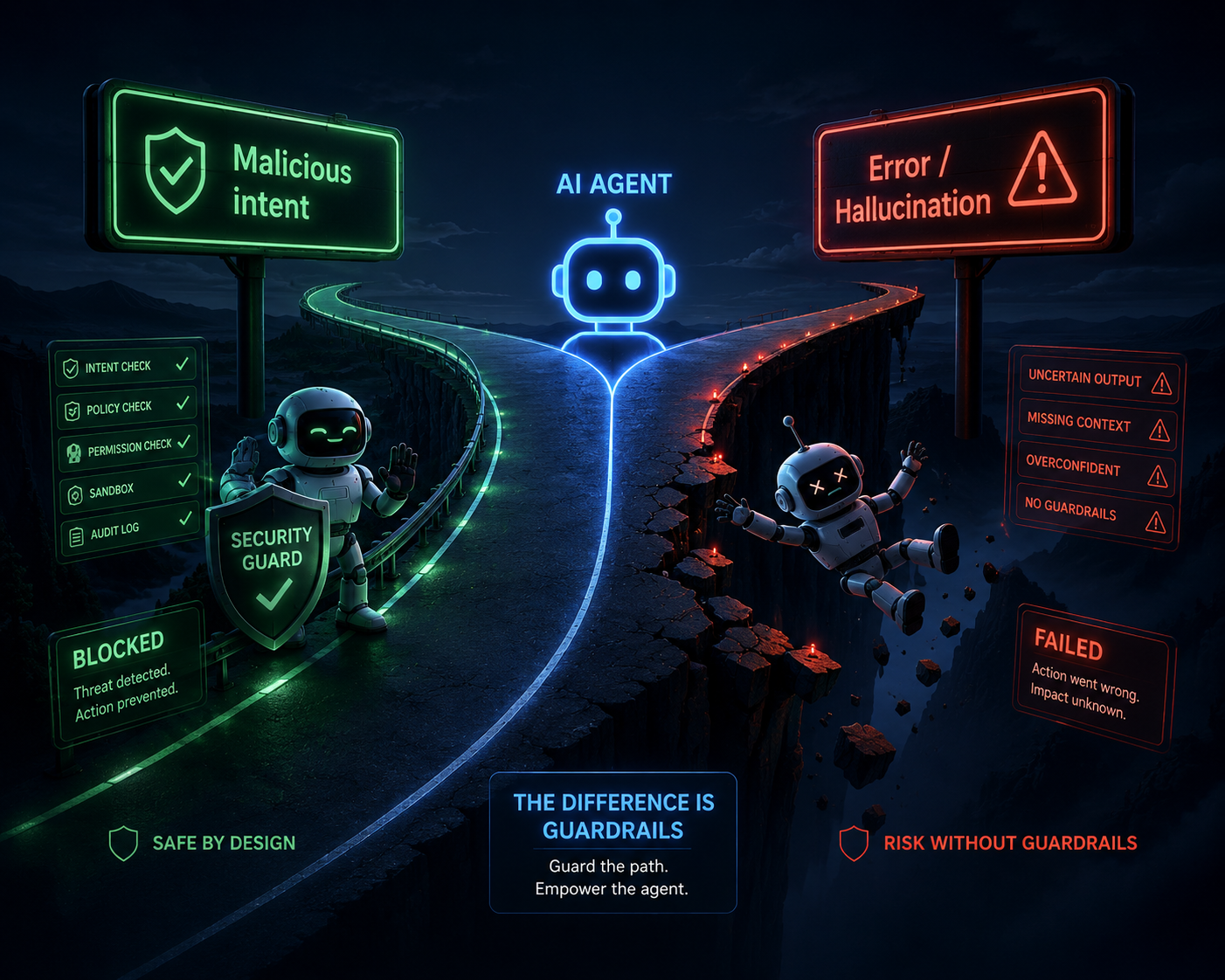
On “YOLO by default,” the author’s exact words: “pi runs in full YOLO mode, unrestricted access to your filesystem, no permission prompts.” The point is blunt: models can always find a way around permissions, so don’t shrink — if you shrink, you’re out of the game. I agree with half of it. Two things need to be said about safety:
- A permission system doesn’t stop “malice.” If a model will circumvent permissions, constraining it with prompts is pointless — the author is right on this.
- Permissions actually guard against “mistakes.” A hallucinating model deletes your production directory; no permissions means an uncontrolled blast radius. So YOLO only holds when “environment is trusted + operations are rollbackable” (personal machine + git as safety net). It does not hold for team scenarios.
This is the line I disagree with most in the whole post: the permission problem has two directions; the author only guards against “malice” and cuts the “mistake radius” line. Fine for personal use — just remember to bring permissions back when you move to a team.
Why the “Absences” Are Fine (Quick-Fire List)
| Absent feature | Why it’s fine | My stance |
|---|---|---|
| todo / plan mode | A “human-machine co-readable md file”, not a framework-internal state machine | Convinced |
| MCP | Full tool schemas in the prompt — too heavy a tax | Partially agree |
| Background commands | What you can’t see you can’t control; multiple terminals don’t interfere | Partially agree |
| Everything built-in | Complexity is debt; resident complexity is uncontrollable | Convinced |
The “Pie” I Most Want to Poke: Lane
Cold water first: Harness v2 is still a design doc in the repo (harness-v2.md), not shipped. (Unverified against the original — per community discussion.) But the design looks like this:
sequenceDiagram
    participant Parent as Parent Agent
    participant Fork as Fork History Tree
    participant Child as Child Agent
    participant Log as Operation Log

    Parent->>Fork: Copy history tree
    Parent->>Child: Spawn subtask
    Child->>Log: Record deterministic ID + operations
    Child->>Parent: Return result
    Parent->>Fork: Reference child history
    Note over Child,Log: Crash-replayable into the same session
    Note over Parent,Fork: Parallel write conflict semantics undefined
Fork copies the history tree; the parent can reference the child’s history (patches “can’t see inside”); deterministic IDs + an operation log guarantee crash-replay into the same child session.
Sounds nice. I have three questions:
- A deterministic ID only guarantees “re-attaching to the same session,” not “re-running produces the same result.” Every tool call a child makes is a side effect (running commands, writing files). Transcripts can be replayed; side effects can’t. The design doc is vague here.
- The parent both shares and writes. The conflict semantics of parallel writes to the same tree are currently undefined.
- “Stateless” has quietly disappeared. Recovery requires persistence and transactionality. The supposedly stateless Pi is patching itself — “light” isn’t a religion; when conditions change, it makes a concession.
When Not to Use It (or Copy It)
- You’re not using a top-tier model — “light” is a consequence of the model, not a cause;
- You want out-of-the-box — it doesn’t even ship with internet access by default;
- Your team scenario needs compliance — YOLO + statelessness inherently conflicts with permission auditing.
If You’re Copying the Homework (DIY Harness)
- Before any feature enters the system prompt, ask: is this attention tax worth it? If it can live in the API, keep it out of the prompt;
- Low-frequency capabilities aren’t installed by default — attach on use;
- State lives in
.mdfiles — don’t build a private state machine; - For multi-agent, start with trace and replay, not with “concurrency”;
- Don’t copy YOLO. Fine on a personal machine with git as a safety net; in a team, replace it with a “permission funnel.”
Closing
The biggest takeaway from studying Pi isn’t “how to use it” — it’s what the “absence list” reminded me of: the real tradeoff isn’t in what you build, but in what you hold yourself back from building. Subtraction is harder than addition, and worth more.
References
- Pi author Mario Zechner’s blog: mariozechner.at (verified: YOLO mode, full bash access, no sub-agents, no default internet)
- Databricks benchmark: databricks.com/blog (second-hand, not verified line-by-line)
- OpenAI — A Practical Guide: openai.com (unverified against the original)
- Anthropic — Building Effective Agents: anthropic.com (verified: higher costs, compounding errors, extra layers of abstraction)
- Zhihu — “Pi agent 毛坯房装修踩坑”: zhuanlan.zhihu.com (unverified against the original)